Capturing Joy with India Mae Alby
People and spaces can change the course of our life pretty radically. A South London Sainsbury’s car park and a local community of rollerskaters had the biggest impact on photographer and rollerskater India Mae Alby.
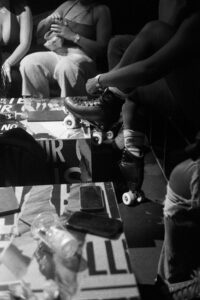
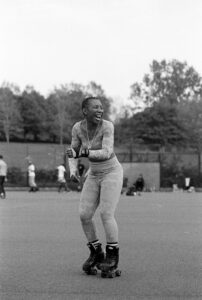
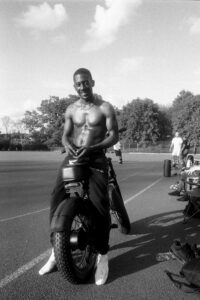
India’s new book, “The London Rollerskating Scene”, is an intimate portrait of the London rollerskating community, highlighting their joys as well as their challenges. We sat down with India to learn more about her practice, discussing the importance of physical exercise, finding community, and accessing spaces to nurture these subcultures.
Interview by Elisa Mazzuca | 16.12.25
Would you like to introduce yourself and your practice a little bit?
I'm India, India Mae Alby. I'm a photographer most of the time; I do it as a job sometimes, but it's my full on personality. To be honest, I love film photography especially. I've been shooting on film since I was 12, and I'm 28 now. I just use it as a way to record memories, essentially. But as I've traveled and then also experienced different things living in London, I have collections of all these film images centered around community; the black British community especially, and joy. Everything I do is because it makes me happy. So everything I photograph is happy as well, which is nice. It's nice to look back on everything.
I definitely get a strong feeling of joy and fun, being careless with your friends, with your community, when I look at your photos. And I think some of my favorite photos from you are definitely the ones about the London roller skating scene, so I wanted to ask you, when did you start roller skating? When did you start taking photos? When did the two things combine together?
So I started like I said, I've been photographing for years and years and years, but I only started roller skating in 2022. I was doing a MA in Photojournalism and Documentary Photography at LCC (London College of Communication) which is part of University of Arts London. I'd been working abroad and moved back to London to rejoin life, and I really needed something to stimulate me. I didn't want to come back for a job, necessarily, so I was doing my masters. As part of that, they encouraged us to do a project where we really challenged our photographic practice. It was called “Rethink”. So I decided to try making a film which I was very uncomfortable and unfamiliar with.
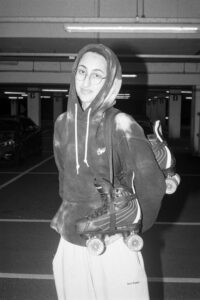
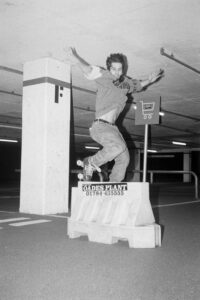
I had a friend who skated, and I started seeing a lot of roller skating videos on Instagram at the time, because around covid it really exploded, but I couldn't really skate still. This friend introduced me to a community called Rolling Distance in South London around Colliers Wood. We just skate in the Sainsbury's car park there. I went there with the intention of making a film about this community, which is quite bold; I kind of just joined knowing exactly what I wanted to do. It all just came together really quickly for me. I didn't even think too hard about doing this project. I just followed my gut. Colliers Wood is not far from where I lived at the time, and I did not have a community in my local area at all.
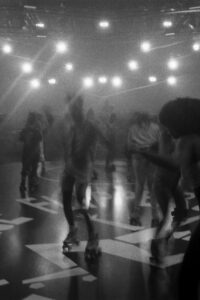
It was a lot of things for me; it was the roller skating, the skill, and then joining the community, making friends, and also documenting them, and my own journey into that. Rolling Distance was my first entry point to roller skating. I learned how to skate, I was photographing and filming from the start, but it was a lot of experimentation. I wasn't putting pressure on myself whatsoever, and I did, within a few months, make a skating film about Rolling Distance specifically. Through them, they introduced me to other skate spots in London, and I started thinking about doing a further project; this was just for me. I won some money from Ilford, a grant to complete the project. I was able to win money with the help of the skate community, because it was a community vote, and the whole community voted for me enough for me to win, and I really wanted to create something that celebrated them, and my whole journey as I was now a confident skater. It had taken me about a year to feel confident and I now felt like I could do more with the camera while skating. I could get different kinds of images and push myself more. So that's what this project was about, the London roller skating scene.
I love it. I feel like it's a proper circular moment, kind of giving back to what prompted you to get into skating. I feel like that's iconic. And I love that you guys meet up at the Sainsbury’s car park! You talk a lot about the sense of community that you feel with Rolling Distance. How does the sense of community affect you as a photographer, as a skater, and how has it impacted your practice and this project in particular?
Community was so important for my mental health. I previously had not wanted to even stay in London or the UK, I'd moved abroad twice before, and I was willing to do it again if I didn't find what anchored me here. But I really did find the skate community at the best time. I made lots of acquaintances, friends, and then my best friend Sam, who's my husband now., We fell in love in that car park!.
You just deepen the conversation. You see these people on a weekly basis, bi weekly basis. I was seeing all these skaters more than my existing long term friends and I fell in love with him [Sam]. I've seen other people join and fall in love with their partners, and people have made really, really strong friendships, just because everyone is committed and consistent. I was really, really consistent, and that's why I was able to become a confident skater. Some people just dabble, and they don’t really progress much, and you have to make a decision, like, I'm doing this several times a week now and strengthening those bonds.
We all provide a space for other people to skate. Everyone has that space because everyone is so welcoming. Everyone is supportive. For example, right now one of the other skaters, his name is NG and he's a DJ, he has a customized speaker/backpack which he takes on street skates and it was stolen from his car two days ago. Someone literally smashed his back window and took it. Now he's trying to have the community help him find it. That's just one example. We do really look out for each other. People hang out in their spare time, go on holidays together, get married. It's amazing.
That's really amazing. I love the story of how you met Sam. Two hearts and a car park!
It was so crazy, that my whole life changed completely within a few months because of him, because of Rolling Distance. Everything completely flipped, it's gone in a completely different direction than I ever expected. It's amazing, it’s lovely.
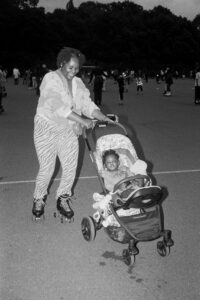
I’d like to ask you about the feeling of joy that we spoke about earlier. So obviously, when I look at your photos, especially the roller skating ones, I see a lot of joy. But what are some challenges that you think this community is facing right now?
I started photographing for this project two years ago. Now, at the time, we had a rink called Flippers in West London. Within a few months, it was just gone. They closed within two weeks, they just put out a notice saying, “Last event this day.” And that's it. They just completely abandoned the whole community, that was a crucial space for us. There were only two rinks in London, one in West London and Roller Nation in North East, but that’s too far for most people in South. Flippers was a bit bigger. People celebrated their birthday there. It was a real place where people could come together, celebrities would be there, you know, you could watch performances. It was amazing. It was really what the community needed. And it's gone, and we've had no replacement since.
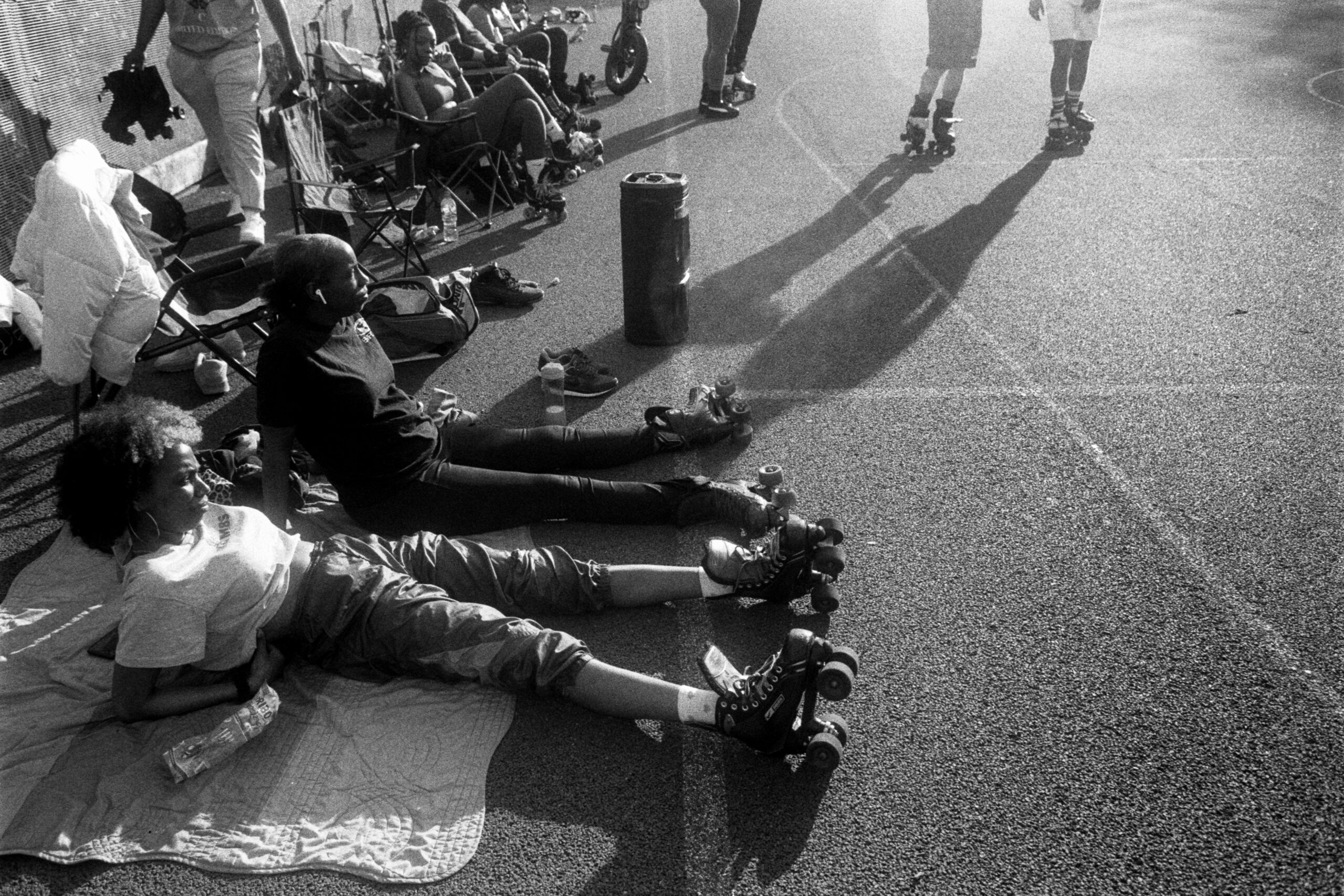
Where we are in South anyway, we have nothing. I skate at Stratford in the summertime. But even around the university campus there, where skaters like to skate, there's issues about access. You know, some of the younger skaters, just a small number of them, maybe don't seem to understand cleaning up, looking after your spaces. Maybe they take it for granted that these spaces will always be there, whereas for those of us who've been there for a few years now, we can see how quickly that access can be denied. It's all about access. We do not have the spaces we deserve, the spaces we need. A lot of us are into American skating, but we can't skate like them because we don't have those smooth surfaces, big rinks, or indoor spaces. Even the one rink we have is not air conditioned. There's a lot of barriers in place; when the weather is good, it's easier to be spontaneous, like, let's just go, let's just do it. But in the winter, which is literally half the year, a lot of us dip out, or we are only able to go to covered car parks. And as far as I'm aware, it's just Colliers Wood, Nine Elms Sainsbury's, and then there's a place called Highams Park. They call it HP. That's like North East London. I've never even gone. It's too far, and that's about it. So we really want to be with each other, but we are finding it increasingly difficult to be with each other, so that joy becomes a bit more fleeting, which is a shame. This really is a lifeline for a lot of people, it strengthens their mental health and community bonds. It's everything for a lot of people, it's good physical exercise too. I wish we had more space, you know.
Yeah, more protection, more space being granted, being allowed to be in spaces.
Not being seen as a nuisance everywhere.
I was just thinking the same, detaching the negative stereotypes about skating, about young people on skates. I feel like that's a very central part of it, too.
Absolutely. Because even though some of the younger skaters leave rubbish and stuff, most of them are fantastic. A lot of them will organize their own events. And I feel like there's even more of a divide now between the older skaters and younger skaters, because the younger skaters are really doing their own thing, which is great, they can take charge as well, and they really embrace the outdoor aspect as well, more than the older ones. So it's really impressive, definitely. The community creates a lot of entrepreneurs, people really use their initiative to create the kind of events they want to see. People make clothes, skate straps, turn ice hockey boots into roller skates and even make music for skaters specifically. There’s so much creativity and passion.
In an era in which everybody has a camera attached to their phone, everybody's making content, how do you think photography as a medium is important to support these communities?
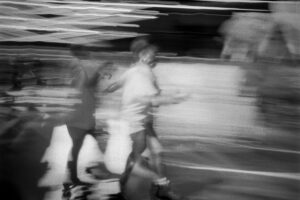
I used to think, “Why don’t I just take videos? I'm trying to capture motion with completely still images.” And sometimes I was like, “Wow, this is really hard. Why have I made this so hard for myself?” But for me, it's a legacy thing, an archival thing. I love the idea of all these images being collated and kept, maybe just displayed in a gallery, in a book, like I've done. I love the idea of it being physical, whereas with a video, you would have to hold an event, show it on a big screen, but it's just not my skill set, and I don't enjoy it as much. I thought I have to enjoy it, and I liked the challenge as well, of trying to capture that motion, especially with film cameras. It has increased my capability with my cameras. I've really had to push myself and allow myself to make those mistakes so I could figure out, controlling shutter speed, exposure, using range finders as well to just kind of guess focus and things like that. It was really different.
There's definitely loads and loads of film images that have been discarded, but at least I had the money from the Ilford grant. Without that, I would have been much more selective, and maybe I wouldn't have even shot the whole project on film. Maybe I would have just done it on digital instead, because it's expensive. But honestly, I wanted to challenge myself, and I did rise to the challenge and learned a lot of things. I know loads of people who shoot videos about the skate community. Instagram is huge, there's so many skate videos on there. So I've provided something different, which was nice. I'm happy I've done that.
I really enjoy looking at the photos. And I do feel like it's something bigger than our time, if that makes sense. People will be looking at these pictures in 70 years, and they will say something like, “Oh wow, people skating in London in the 2020s, how great!”
That's crazy! But yeah, literally, whereas I don't think people will look back at the Instagram reels!
I guess It also doesn't really belong to you, because I can have like, a million followers on my skating account, but if meta decides that account belongs to them, now there's not much that I can do.
It's really important for me to have ownership of all my images. I'm very careful about keeping them in the correct folders, and maybe one day, I’d like to make a website as well. Maybe put it all on a website or something. It's something to think about, but it's a whole other job.
"Those of us who've been there for a few years now, we can see how quickly that access can be denied. It's all about access. We do not have the spaces we deserve, the spaces we need."
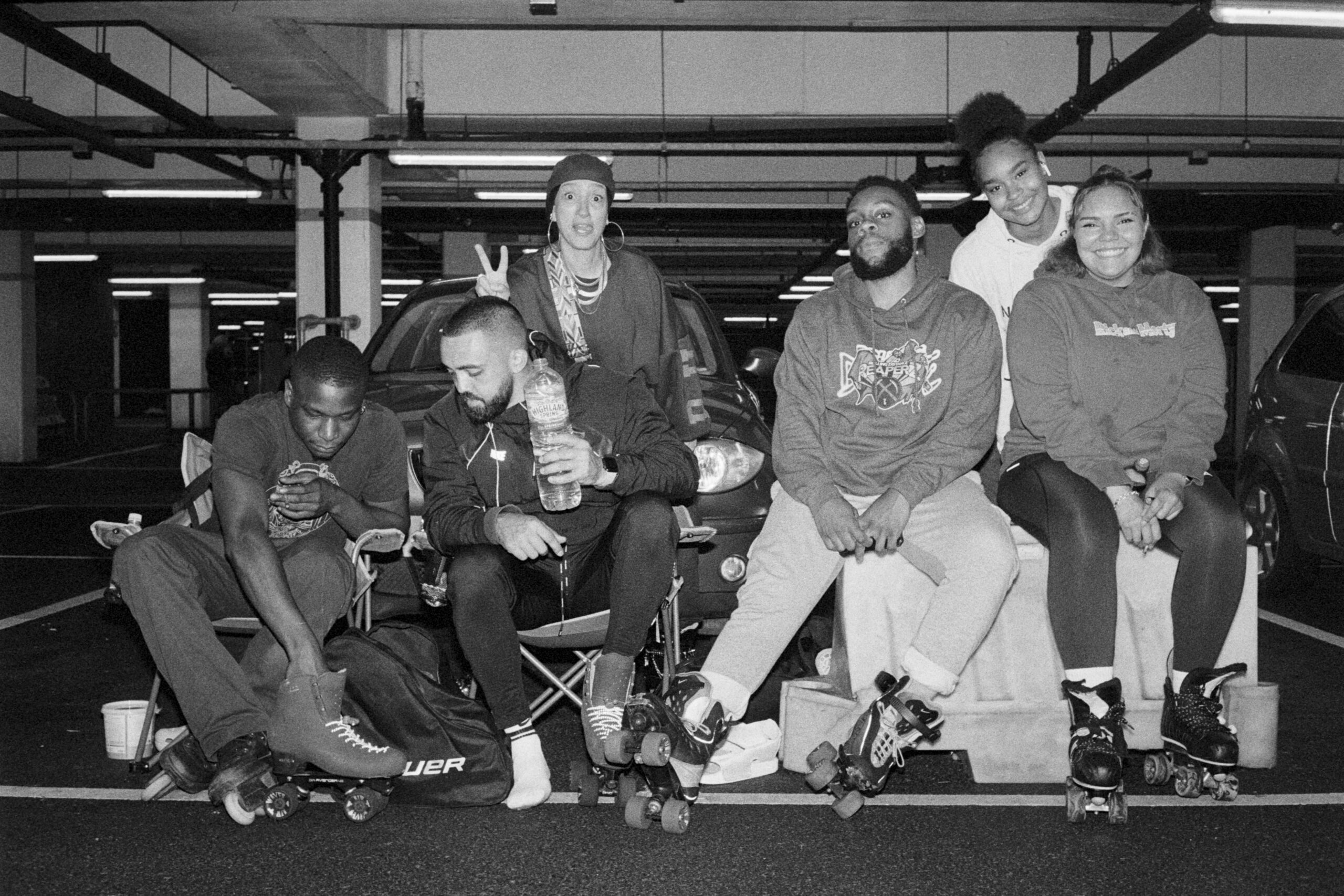
How do people usually react when you're skating and you suddenly start documenting these moments with your camera?
I was so nervous initially. When I joined Rolling Distance, I was so, so, so nervous. I couldn't even skate and I was there with the camera too, it was so scary. There's been times where I've put the camera down for a couple of months and made sure I was focusing on the skating, I didn't want to fall, I didn't want to injure myself, and then I also didn't want to be skating so slowly that I'm not keeping up., there was a lot to figure out in terms of being able to control my stability on my skates. When I need to be still, or when I'm moving, even skating backwards and photographing - that was another level I was able to get to, which is really cool practice. Then on some street skates in the summer, which was really good, and no one was ever hostile, no one was ever negative, they'd just be curious. They come and say, like, “What is this for?”. I don't know everyone in the images. I would like to try and find every single person I photographed so they can see, especially if I exhibit at some point, I'd love for them to come and see themselves like that. Everyone has been so, so, so nice, helpful, willing to pose, even giving me suggestions. It's been quite collaborative and really, really fun.
That's really amazing, community support is so important.
I have one last question for you: if you could donate one object to the Museum Of Youth Culture, what would that be?
Oh, my God. Great question. You know what, now that I'm thinking about it, if NG ever wanted to retire, if he gets his speaker bag back, that would be such a great donation. A custom made street skate speaker. He creates a whole mini community around him. When we go street skating, there's also another guy - I can't remember his name - but he cycles along with us during street skates, and he has some huge speaker and this huge Palestinian flag that he waves in the wind while we're skating around London. That, for me, just kind of sums it all up. The people who provide the music, the way we can make an event anywhere or just escape. Or maybe it would be a pair of skates with some really worn down wheels, something like that. Sorry, I've just given multiple answers!
All of them were great answers! Thank you so much for your time India, I really enjoyed talking to you, I love your photography so much!
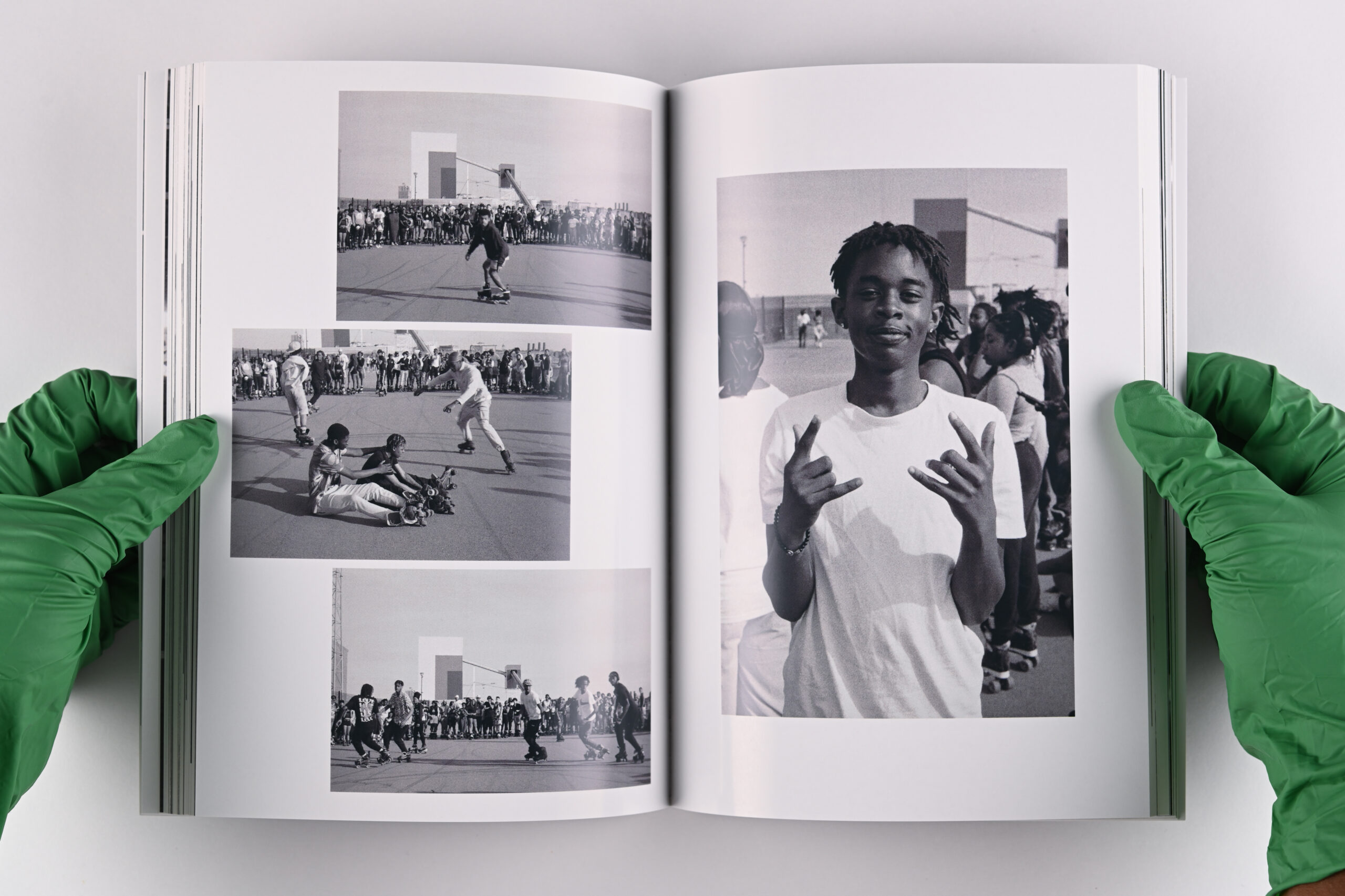
India's latest photobook, 'The London Rollerskating Scene' is available to purchase via India's website
You can follow India and support her work via Instagram here.