An Archivist's Diary: Records of Resistance with MayDay Rooms
MayDay Rooms has become an essential space for documents of protest, resistance and collective action. As both archive and meeting point, it continues to connect past struggles with present movements. We spoke to the team about its beginnings, its growing collection, and the political urgency of preservation.
By Yeliz Zaifoglu | 28.4.25
What is the origins of the MayDay Rooms archive? How and when did it start?
In Britain 2008 and following years were marked by brutal austerity cuts to public services, the closure of many public libraries, community centers, and cultural spaces. Concurrently, the hikes to student tuition and the closure of many of the more politically activist university departments pushed more and more radical leaning voices out of education all together.
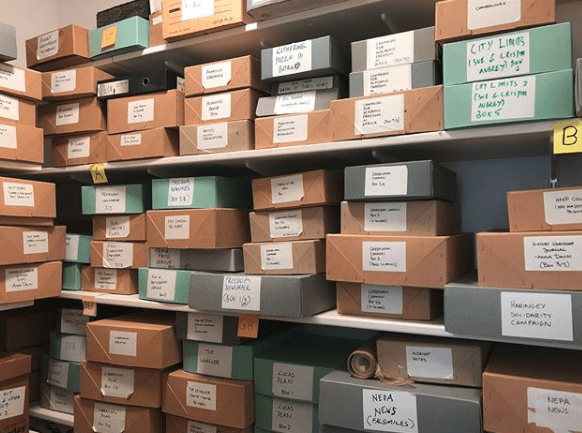
MDR started with a number of ‘unboxing’ events at the Marx Memorial Library in London, where our three founding depositors – George Caffenzis, Silvia Federici and Peter Linebaugh –, each addressed one of the collections that they deposited: the Marxist-feminist campaign Wages for Housework NYC (1972-81), Midnight Notes Journal (1971-2001) and New England Prisoner Association News (1973-75).
These three collections alone offer a wealth of insights into feminist struggles, domestic labour, sex work, radical education, abolition, anti-fascism and anti-racism, Italian autonomist Marxism, the anti-nuclear movement, land struggles, Palestine resistance, rent strikes, wildcat strikes, to name a few…!
MayDay Rooms went from this itinerant collection of materials to an archive with a physical building in 2013. Austerity policies in combination with the anti-squatting laws passed in 2011, which criminalized the squatting of residential property ruined many social and communal spaces, many of which acted as containers of cultural memory and histories.
Within this context of continued loss or destruction of space, MDR positions itself as a counter-institution dedicated to safeguarding histories and documents of struggle and resistance.
The primary concern of the archive is as a place to make the materials useful to groups of people engaged in struggle today. This means the archive is freely available to access, the vast majority of materials are licensed under a Creative Commons, ensuring the materials are freely available for re-use, modification, and sharing, as long as proper attribution is provided. To extend the idea of accessibility and distribution of the materials contemporary struggle and protest we are continually digitizing our collection, which is available through our website.
What is a day in the MayDay Rooms archive like?
Speaking from today! We answered email inquiries that had come in during the usual four days a week that we are closed. Then people visit throughout the day. They either book a date and time or they can pop by during opening hours. There’s a lot of sorting out, looking for and finding materials that people want to access. We also spend some time with people helping them if they want with the type of materials we have that might be useful for their studies and research. Today we spoke with a young researcher at length about housing struggles in London in relation to her dissertation project. We also pulled out some ‘subvertising’ poster for a graphic artist interested in how to use media to get out different critical messages in unusual and striking ways.
Today, we did some social media showing off some lovely old archival material but asking the question of what the material is without a person looking at it? By this we mean that the content, context and consequences of any archive piece is only ‘activated’ by the people thinking about it.
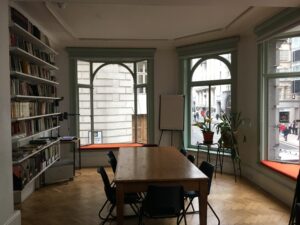
Sometimes we have events in the building such as film screenings, workshops, making sessions or just old fashioned community or political groups meeting to plan their activities. We are fortunate enough to have a Screening Room and a Reading Room for this purpose, and a full kitchen.
The archive focuses on links of past social movements to current, can you talk about the importance of making those connections in the collection?
Yes. One of our core objectives as an archive is to contribute to contemporary activism, organising and social struggles. There are a number of ways we try to do this; how we arrange our collection, how we make it accessible, how we invite people into the space, and with projects and programming.
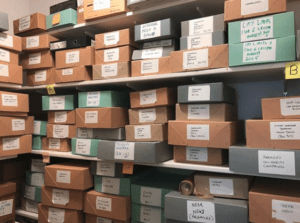
Traditional archives are often organised in such a way where you ask to see a single item by reference number. This process can make things hard to access, perhaps intentionally so, and browsing is out of the question. Because the MayDay Rooms archive is not arranged in this traditional institutional way, it’s always possible that you come across something unexpected. Someone may come in to look at rent strikes, they may then find the boxes on squatting, which may lead them to protest camps and anti-military and anti-colonial organising, and so on.
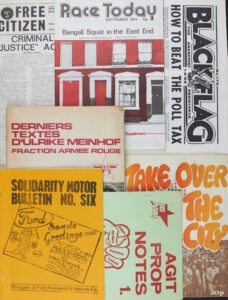
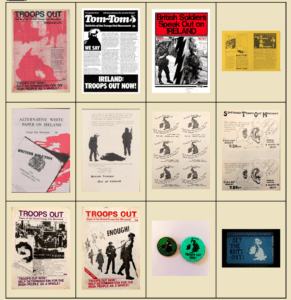
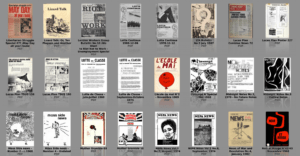
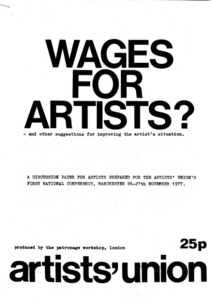
The collection at MDR focuses on anti-authoritarian, extra-parliamentary social struggles from radical art, and creative acts of resistance from the 1960s to the present. It contains everything from recent feminist poetry to 1990s techno paraphernalia, from situationist magazines to histories of riots and industrial transformations, from 1970s educational experiments to prison writing. Drawing from situationist methods perhaps, it can be interesting to see what happens when seemingly disparate ideas come together, in the case of MDR, because of course there are always connections to be made, ones that more sequestered archives obscure through complex cataloguing and item specific requests.
With our digitisation, again the idea is to both house and circulate materials so that they can be shared in common with social movements today. Our platform Leftove.rs also brings the archives into circulation and creates a type of common non-proprietary ownership.
Rather than it just being a repository where material is merely stored, how might we disseminate, programme around, re-use and repurpose the collection? We have recently reintroduced a Risograph printer (stencil duplicator) to the reading room, it will be interesting to see in the coming months how groups who use the building put this machine to work. In fact, MayDay Rooms is located in a historic area for struggles regarding print.
Are there any collections in the archive that stand out to you, or that are your favourite?
Ah! Nice question! We have Schooling & Culture materials about state education and young people’s creation of their own cultures produced in the mid-80s. We also have Libertarian Education magazine which offers a much wider radical outlook on the form and notions of state (and other) education. We also have lots of community work projects done with young people in schools, art centres and adventure playgrounds in the 70s. Outside of formal education we also have a collection about rave culture and especially that culture in its more underground form of squatted parties and the politics surrounding that.
Yeliz
Have there been any recent acquisitions that felt really profound or special when archiving them?
MayDay Rooms
We are currently working on a two year project based on a new collection from the environmental direct action movement of the 1990s and early 2000s. These activists pioneered tree villages and tunnels as tactics of resistance against the destruction of nature by road building, quarrying and a spreading tide of concrete as well as resisting deforestation, car culture and genetic engineering. Really creative and strange innovations which lead to a lot of successful outcomes, and of course, some less so. These materials also contain a lot of ephemera from Reclaim the Streets, and speak to really lively street protest and soundsystem cultures.
Any exciting 2026 plans you’d like to plug?
Yes, we’re always running a lot of events around our collections, as well as film screenings, reading groups, skill shares and various other things. You can check out our instagram @maydayrooms or our website for up to date listing.
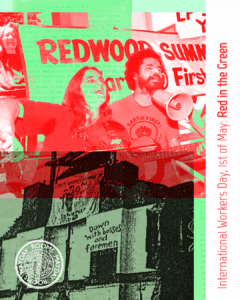
One that it makes sense to plug is our International Workers day, or May Day (1st of May) event which links directly to our eco-anarchist collection. MayDay Rooms' name, which is drawn firstly from International Workers’ Day, and secondly from the international distress signal. Both references express the emergency facing the radical heritage through austerity cuts and the enclosures of space, but also an anticipation of future festivities in a better world of our own making symbolized by 1st of May.
Find out more about MayDay Rooms' archive on their website and their Instagram
You can also learn more about their upcoming May 1st event