Sahani Saani with Nitesh Tailor
How to bring food into the archives, a space its often banned from? With his supper club, Nitesh Tailor uses food and community as a springboard to discover and discuss the archive. Starting at home with his family archive, he has built a collection that explores the culture of the Indian Ocean. Yeliz went to one of his supper clubs to find out how the physicality sparks new conversation.
By Yeliz Zaifoglu | 26.08.25
The very prospect of archiving and food feels wrong at first, even criminal. You are taught that food and drink are the villains of the archive, a thing to be banished for the sake of the survival of your archival children. I’ve always met this attitude with a silent eye roll (internally) and ultimately, compliance. I’m a hypocrite if anything as I stare at the ‘No Food & Drink’ sign hung up by myself in MOYC. The general rule is understandable, but something felt silly about it. Food and drink are so important to so many cultures how could it not have a place in the archive? Especially considering the fact food is essentially left out of archives unless it is its sole purpose - shout out the Museum of Disgusting Food in Berlin. This was not the case for my evening at Sahani Saani.
Nitesh Tailor is an archivist that flips all those feelings on their head, thankfully. I met Nitesh by chance at South Bank during the Azeema Weekender in 2024. Nitesh was chatting away to our mutual friend and naturally my attention spiked when I heard the mere mention of archiving. Eventually, he explained Sahani Saani and I couldn't resist but to put it on my list of things I must drag my socially awkward being to. And that I did.
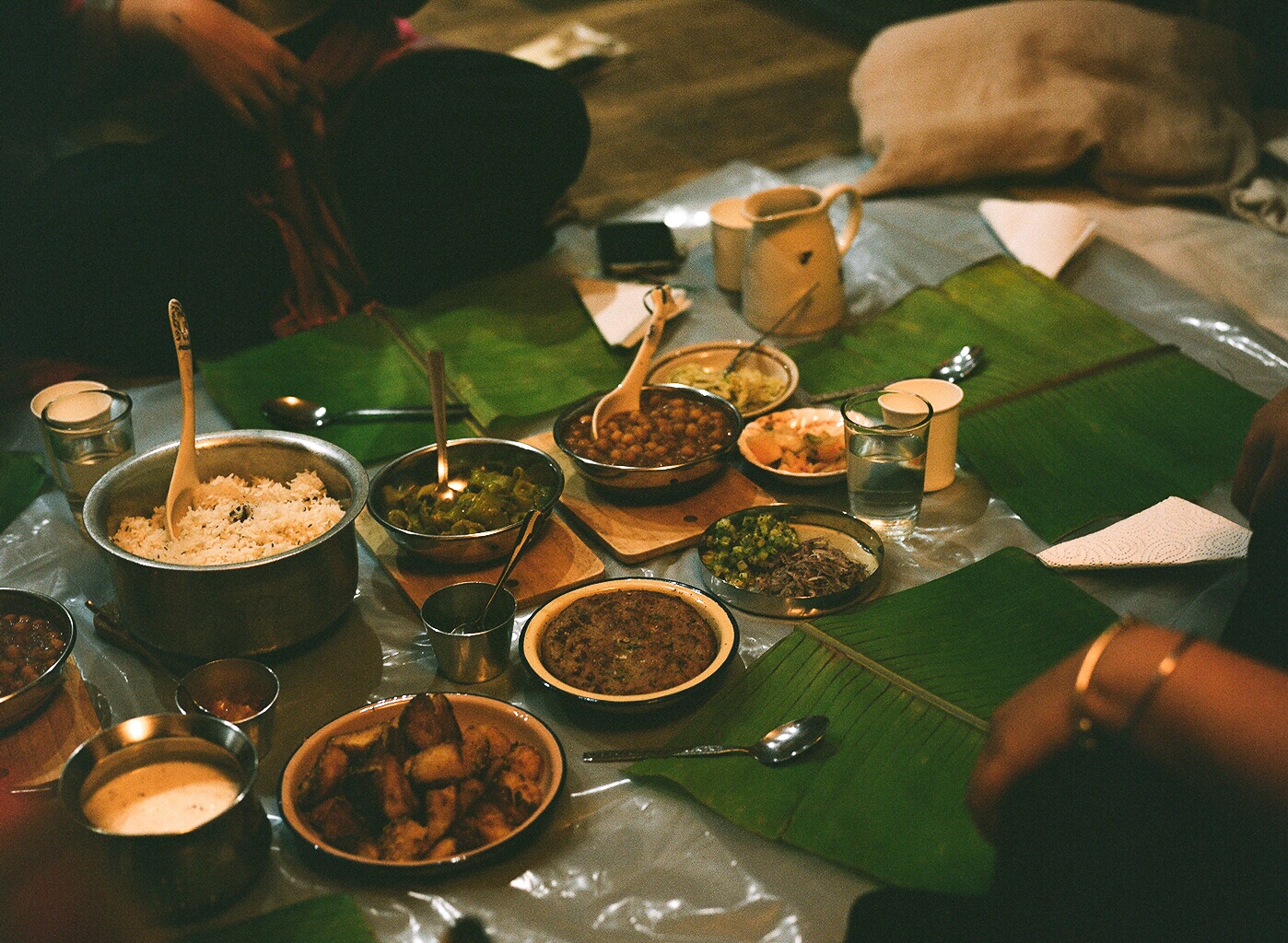
Something as precious as being welcomed into the home and history of a family you don't know with such love is not to be taken lightly. Nitesh curates an evening of warmth - physically and emotionally - whilst provoking you to think in the most gentle of nudges - what even is an archive? And why can't food be involved? As you walk in you are greeted with banana leaf plates, Nitesh and parents cooking away and other curious heads deciding whether to sit on the floor or at the table. From Chana nu Shaak, Sekela Batata, Pilipili, Apple and Pear Murabba and more, the dishes were there to be simply enjoyed.
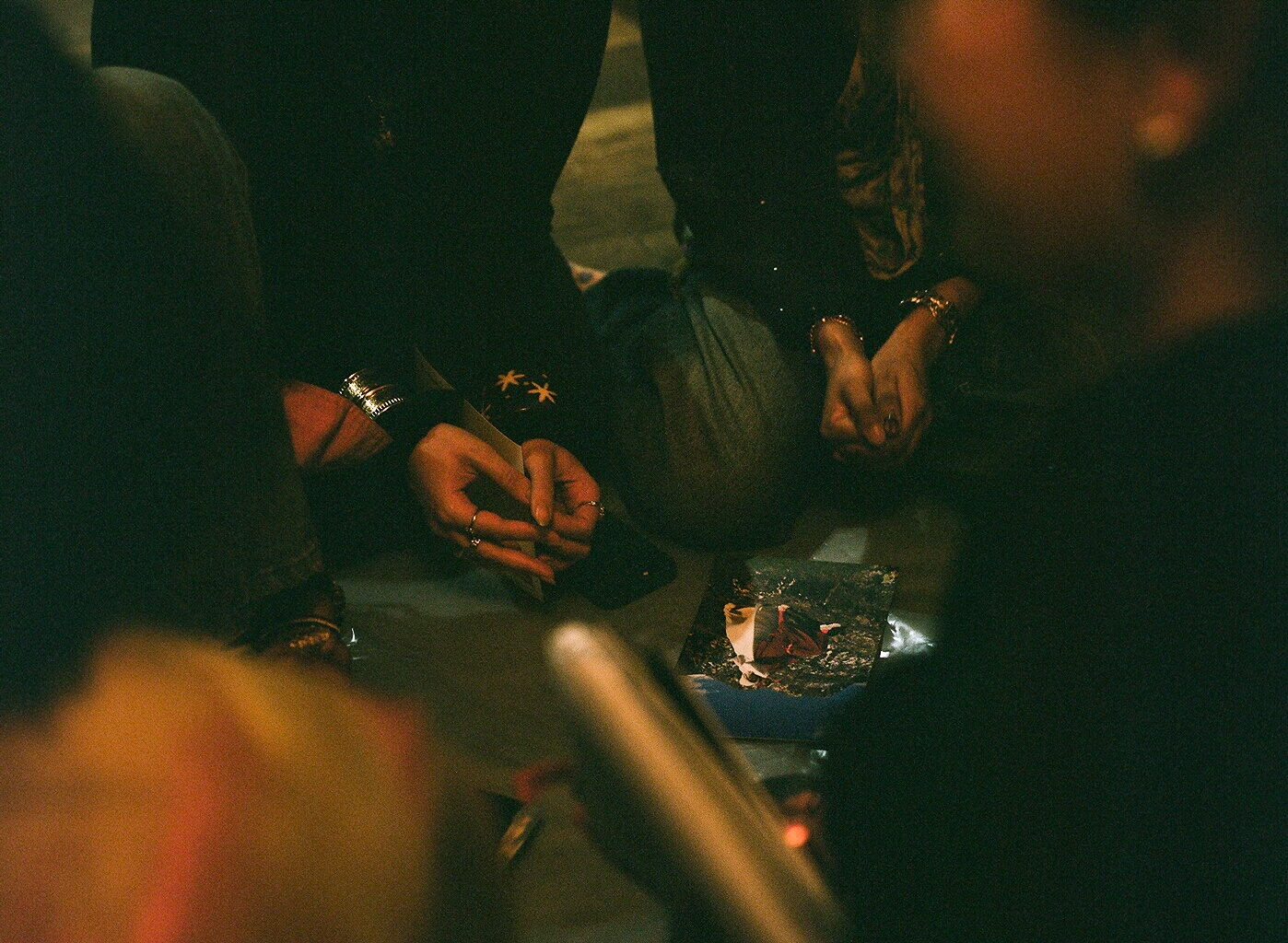
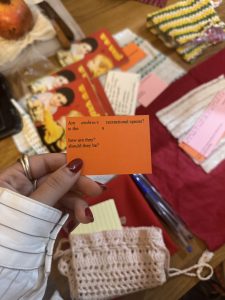
After eating and warmed by Chai, you’re embraced by the physical archive. I sat with strangers and became a collective, flicking through album pages of Nitesh’s family archive. Beautiful, classic family images of weddings, births, funerals and fun delighted us as we imagined who these people were. We naturally created these stories and links to our own various cultures through these images, bonding with touching knees and rampant imaginations. The archiving table had prompts that asked of you to truly think about what you were interacting with - oddly enough the one that stuck with me most was simply ‘how important is captioning? Is it?’.
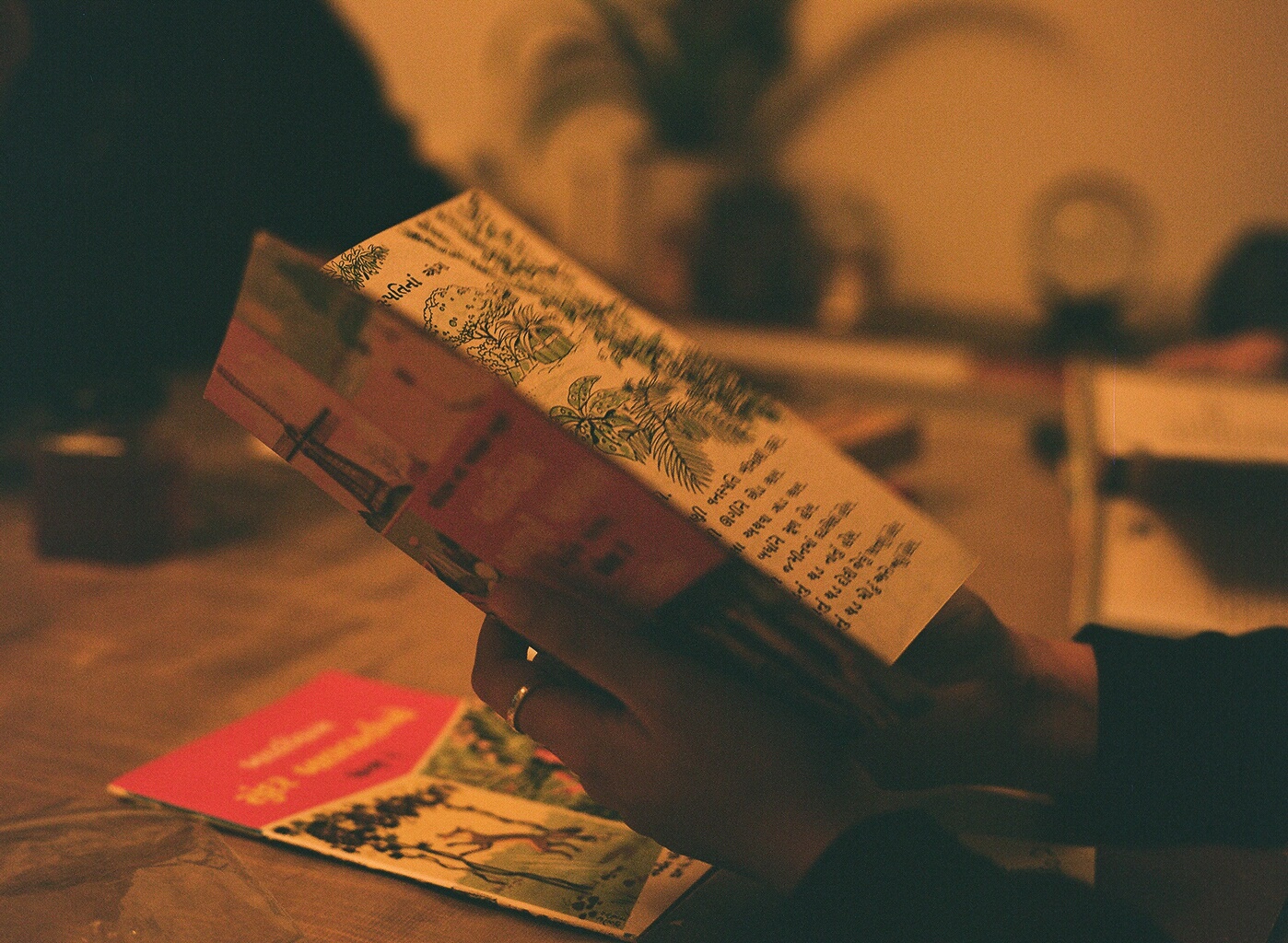
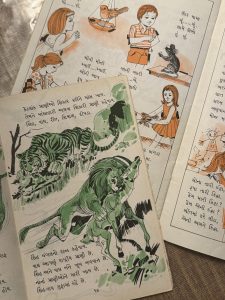
One of us cut up the pomegranate to share, another used the camcorder, many of us used the albums, few got mehndi and I personally was infatuated by the language learning books. They reminded me of the Turkish learning books that plagued my life as a young person grasping two home languages. It was essentially free roam, as Nitesh trusted us to interact with what he had collected. What I was left with was a plethora of new friends and many new moments of pure curiosity and comfort to stir with - for that I thank Nitesh handsomely.
Before I go into the interview, I wanted to mention a very honourable moment: a new friend from the supper club initiated a moment that I couldn't get over. It was a gorgeous minute that filled the most tender of spots. Nitesh welcomed his room as a space to explore his cassette collection but also as a prayer room, however he didn't have a prayer mat. In turn, this new friend offered hers to the group. Although the smallest of gestures it reinforced something within me that this was a space to truly melt into and become one with. You eat, laugh, learn and share together as strangers at first and then as intimates.
Introduce yourself! Who are you & what do you do?
Hi, I’m Nitesh, I’m an interdisciplinary artist and archivist from East London. Currently I’m working on developing a community archiving space which I hope to open to the public later this year. This is a continuation of what I’ve been doing for the past year, which is running Sahani Saani, a space in which I organise suppers and discuss all things archiving!
What is Sahani Saani? How did it come about?
Sahani Saani is a food initiative which engages people in the culinary histories of Western India and the Swahili Coast. It exists as part of a yet to be named community archiving space for Global Majority and POC folk (still trying to find a more appropriate term) which I’ve been informally running since early 2024.
Initially Sahani Saani was just a community supper – at the time I started it I had been in the food industry for three years. It was rough, especially in those last six months when I was working with organisations that took the love out of cooking. I knew that if I wanted to continue working with food, I’d have to find a way to make it joyful and meaningful again. That’s when I decided to organise a big dinner at my parents’ house for my friends, and some people that I wanted to get to know better!
To be honest I wasn’t sure if it was going to be a long-term thing or not. But after my friends told me that they’d had a really wholesome evening and that I should be doing more of these kind of events. That’s what pushed me to actually give Sahani Saani a proper go.
Why did you choose food to be the forefront of the archiving evening ?
It wasn't an intentional choice. Initially I thought “I want to feed all the amazing people who I’ve met in the past couple years” - so initially the idea was a celebratory meal. I’d taken a break from hosting archiving orientated events because I wasn’t quite sure what I was doing or in what direction I wanted to take them. During that break, I invested a lot of time into learning about different archiving and storytelling traditions. This is what prompted me to shift direction with Sahani Saani. One thing I’ve been thinking about a lot is how archives are and can be recreational, transient spaces. Maybe we’re always carrying the archive with us? If I’m having chai with my mum and she decides to tell me a story about when she was younger, for that moment we’ve decided to temporarily station the archive. Here, the sharing of chai is the recreational activity, the conduit for that story. I’m not saying that you need a recreational activity to access the archive, I just think it helps to jog our memory and can facilitate more personal interactions with not only the physical archive, but the community who we are sharing it with.
So, I guess what I’m trying to say is that food was at the forefront of the evening because it was what provided an initial passage into the archive. It also created a comfortable environment for experimentation – I was able to see for myself how this new community archiving space could look.
What is in your current physical archive ?
So much!! There are too many items for one person to organise; from my last count, there are more than 1800 images, close to 100 pieces of literature, and over 300 other items including audio pieces, textiles, and electronics. There's even pieces of furniture, and tea chests from the 1940s. The physical archive started as a repository of family materials so that still pretty much makes up most of the archive – I’d say it accounts for roughly 70%. In terms of the focus, I’ve chosen to only house materials relating to the Indian Ocean, mostly India and Kenya. That’s where my heritage is rooted and it’s the area I’ve explored most – in my personal life, whilst I was studying, and through my art practice.
Considering this, my experiences don’t justify me housing items beyond the remit of the Indian Ocean – I don’t have the necessary knowledge nor skill to take care of them meaningfully. Beyond this, at the moment it's only me who is managing the physical archive and it is an incredibly consuming task. Since most of the materials were passed down to me by family elders, their contexts were transmitted through oral traditions which are incredibly difficult to capture, let alone “sort.”
This is why the physical archive doesn’t resolutely prescribe itself to any conventional cataloguing methodology which makes finding items an action only I can complete. This poses some obvious and major obstacles. So, for the foreseeable future, the physical archive will remain a home for the histories and cultures of the Indian Ocean – there is still much work to do!
How do you wish to expand your current archive / archiving practice?
For now, developing upon the previously mentioned community archiving space. There are so many things to do like getting a team together, forming a core ethos, and even coming up with a name!!
Even though this is all yet to be done there are a few ideas which I’ve been working on which I want to be central to the community space: The first one has to do with “organising” the physical archive itself – the archive is in an interesting moment, all together there’s over 2000 materials and 95% of them are yet to be captioned or catalogued. So, there’s a lot of room to try new things out, and I’m quite sought on not following a definite or established cataloguing process. Instead, I want to work with artists and archivists to produce interesting and imaginative pieces to present the archive’s various collections.
Another priority, not only for the new community archiving space, but my personal practice is developing a set of workshops exploring the fragmentation of memory. Last summer, I ran an event called ‘Running Out of Dishes’ where I delivered a short presentation which proposed “that the fragmentation of memory can be a useful tool for us to understand and contextualise our histories”. Since then, this notion has preoccupied my practice - it’s something which opposes the institutional archives pursuit to standardise cataloguing processes and description practices.
On the archiving table you had card prompts and loads of interactive elements woven into it, what was the information behind having it displayed like that?
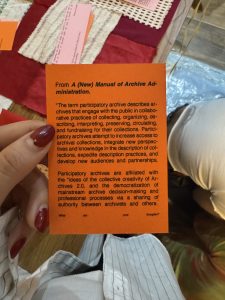
I wanted to offer more of a guided experience without directly telling guests what to do. For instance, I made a little actions zine – it had no words and only partial scans of pages from the archives collection of language learning resources. There was a set of directions accompanying the zine which encouraged participants to act out the actions shown on a randomly selected page however they interpreted them. The actions corresponded to elements within the archiving display. To supplement this task-based activity, I made a few prompt cards which asked questions like: “how important is captioning” and “are archives recreational spaces?” This was the first time I’d presented the archive like this and beyond wanting to improve people’s experiences interacting with the archive, I wanted the evening to be loud! I didn’t want the sole focus to be archiving, it was just as important to me that people felt comfortable enough to converse freely amongst one another and form connections.
What’s the importance to you of having an archive that is interactive ?
Institutional archives often manufacture a disconnect between the contents of the archive and its viewer. How an archive chooses to realise its physical space, caption its artefacts, and even train its staff are contributing factors. They can make entering archives feel boring and sometimes isolating.
I mean, I don’t run an institutional archive. I don’t even have a permanent physical space, so I guess these considerations are inconsequential, right? Well, the way I see it is that existing outside of the institution doesn’t absolve you of responsibility. I can still reproduce these same systems in one way or another, so I’m always thinking of ways to make the archive a comfortable, personal, and relevant space. I’ve found that having an archive which is interactive in as many ways as possible helps to realise this vision. For instance, the damaged pieces in the archive – it’s perfectly reasonable to have certain measures in place which limit the viewers ability to physically handle them so as not to further compromise their condition. But this doesn’t mean that the audience shouldn’t interact with the piece. It’s my job to find a way for them to do so! At the end of the day the archive is a community space, and if the community have no real way of interacting with it, what’s the point?